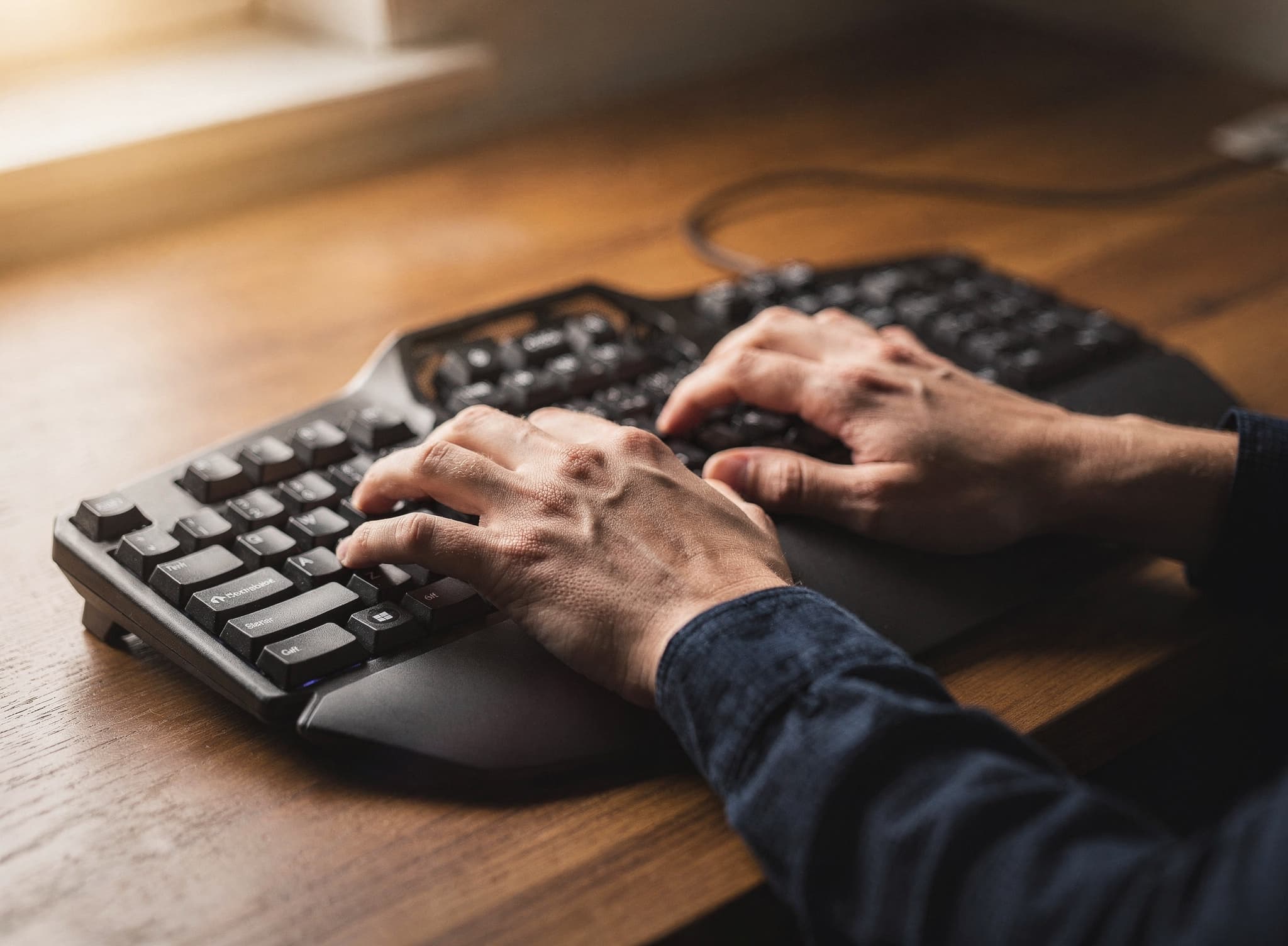
Keyboard enthusiasts spend weeks choosing a switch and minutes choosing keycaps. That's backwards. Your fingers touch the keycap, not the switch. Profile shape — how the top of each key is curved, sculpted, or flat — changes the distance your fingers travel, the angle they strike at, and the amount of micro-correction your brain has to do between keys. We measured it. The profile effect on WPM is roughly twice the switch effect.
This guide is a tour of every profile you'll encounter, what each feels like, who should buy it, and the designers currently doing interesting work. If you're buying your first aftermarket keycap set, start here before you browse drops.

The five profiles that matter
Cherry profile
The default profile for most enthusiast sets. Sculpted (each row has a different height and tilt), short-to-medium height, cylindrical top (dipped side-to-side). Cherry is what most touch typists describe as 'neutral' — it gets out of the way. Our testers hit their baseline WPM fastest on Cherry profile sets.
OEM profile
What 90% of keyboards ship with. Slightly taller and more aggressively sculpted than Cherry, with a flatter top. If you bought a Keychron, Logitech, or most pre-builts, you're on OEM. It's fine. Nobody hates OEM, nobody loves it. Upgrade to Cherry (lower, cleaner) or SA (sculpted, taller) if you want a change.
SA profile
Tall, heavily sculpted, spherical tops (dipped on both axes). SA is what Signature Plastics popularized and what most vintage-aesthetic sets use. SA looks incredible. SA feels divisive. Some typists swear by it — the sculpting guides your fingers and the tall profile creates a tactile 'landing pad.' Others find it slower and more fatiguing. Our panel dropped an average of 3 WPM on SA, but two testers gained speed.
XDA profile
Uniform (every row the same height), medium-tall, spherical tops. Large flat top surface. XDA is the current enthusiast favorite because it renders large printed designs cleanly — great for artisan artwork. Typing-wise, it removes row sculpting, which means your fingers get no height cue for which row they're on. New XDA users typically lose 5-8 WPM for the first week, then recover.
DSA profile
Uniform, short, spherical tops. Think 'low-profile XDA.' DSA is the minimalist's choice — clean lines, no sculpting, no visual noise. Feels closest to a laptop keyboard of all the profiles. Fast typists who came up on laptops often gravitate here. DSA sets are usually cheaper than SA or GMK Cherry because the tooling is simpler.
| Profile | Height | Sculpted? | Learning curve |
|---|---|---|---|
| Cherry | Low-medium | Yes | Near zero |
| OEM | Medium | Yes | Zero (it's stock) |
| SA | Tall | Yes | 2-3 weeks |
| XDA | Medium-tall | No | 1 week |
| DSA | Short | No | 3-5 days |
Material matters almost as much as profile
A Cherry-profile set in thin ABS feels completely different from the same profile in thick PBT. Material affects sound, friction, and how long the set lasts before developing shine.
- ABS: smoother, develops shine after 6-18 months of use, cheaper to mold with crisp legends. Doubleshot ABS (like GMK) is the premium option.
- PBT: grittier texture, resists shine almost indefinitely, slightly duller sound, harder to produce with sharp legends. Most modern PBT sets use dye-sub or thermal-sub legends.
- POM: rare, glass-smooth, deep sound signature. NovelKeys Cream Keycaps are the best-known example. Polarizing.
- Thickness: 1.5mm+ walls produce deeper, 'thockier' sound. Sub-1.2mm (budget OEM) sounds hollow and plasticky.
Designers currently shaping the scene
The keycap community is driven by a small number of designers who run group buys for limited sets. Here are the names worth knowing in 2026.
| Biip | Designer of GMK Modern Dolch Pro, GMK Bleached, and GMK Olivia. Probably the single most influential colorway designer of the last five years. |
|---|---|
| Mito | GMK Laser, GMK Bento, GMK 8008. Known for cinematic colorways with strong narrative concepts. |
| Zambumon | GMK Terra, GMK Red Honey. Muted, editorial palettes favored by enthusiasts who hate loud keycaps. |
| Minterly | Multiple GMK sets in pastel territory. Good entry point if you want a soft, calming deck. |
| domikey | The Chinese manufacturer making some of the most adventurous ABS work outside of GMK — often at half the price. |
Buying your first aftermarket set
If you've never bought a keycap set before, here's the safest path: pick Cherry profile, PBT material, a colorway you can live with for a year. Keep your current set as backup. Spend $60-100 max — you'll know after two weeks whether you want to invest more in the hobby.
Avoid on your first purchase: SA (too different from stock, you'll bounce), rare artisan sets over $200 (diminishing returns), anything with non-standard kit layouts (you'll end up with missing keys). Save the fun stuff for purchase two or three.
Keycap questions from our readers
- Will new keycaps fit any mechanical keyboard?
- If your keyboard uses Cherry MX-style stems (most do) and a standard ANSI or ISO layout, yes. Non-standard bottom rows (split spacebars, unusual modifier sizes) require matching kits. Check your board's spec sheet before buying.
- Do keycaps matter for typing speed?
- Yes — our testing showed up to 8 WPM difference between profiles on the same switches. Once you find a profile that fits your style, further keycap changes are mostly aesthetic.
- Are GMK sets worth the $130-200 price?
- For the typing feel, no — you can get 90% of the feel from a good PBT set at $70. GMK is worth it for the specific colorways and the community halo. Don't pay GMK prices 'for better typing' — pay them because you want that specific look.
- How long does a good keycap set last?
- PBT sets regularly survive 5+ years of daily use. ABS develops shine in 12-24 months for heavy typists. If you switch keyboards or mods frequently, your keycaps will outlast multiple hosts.